
I need a Lawyer (Or Spook Does!) Part 1.
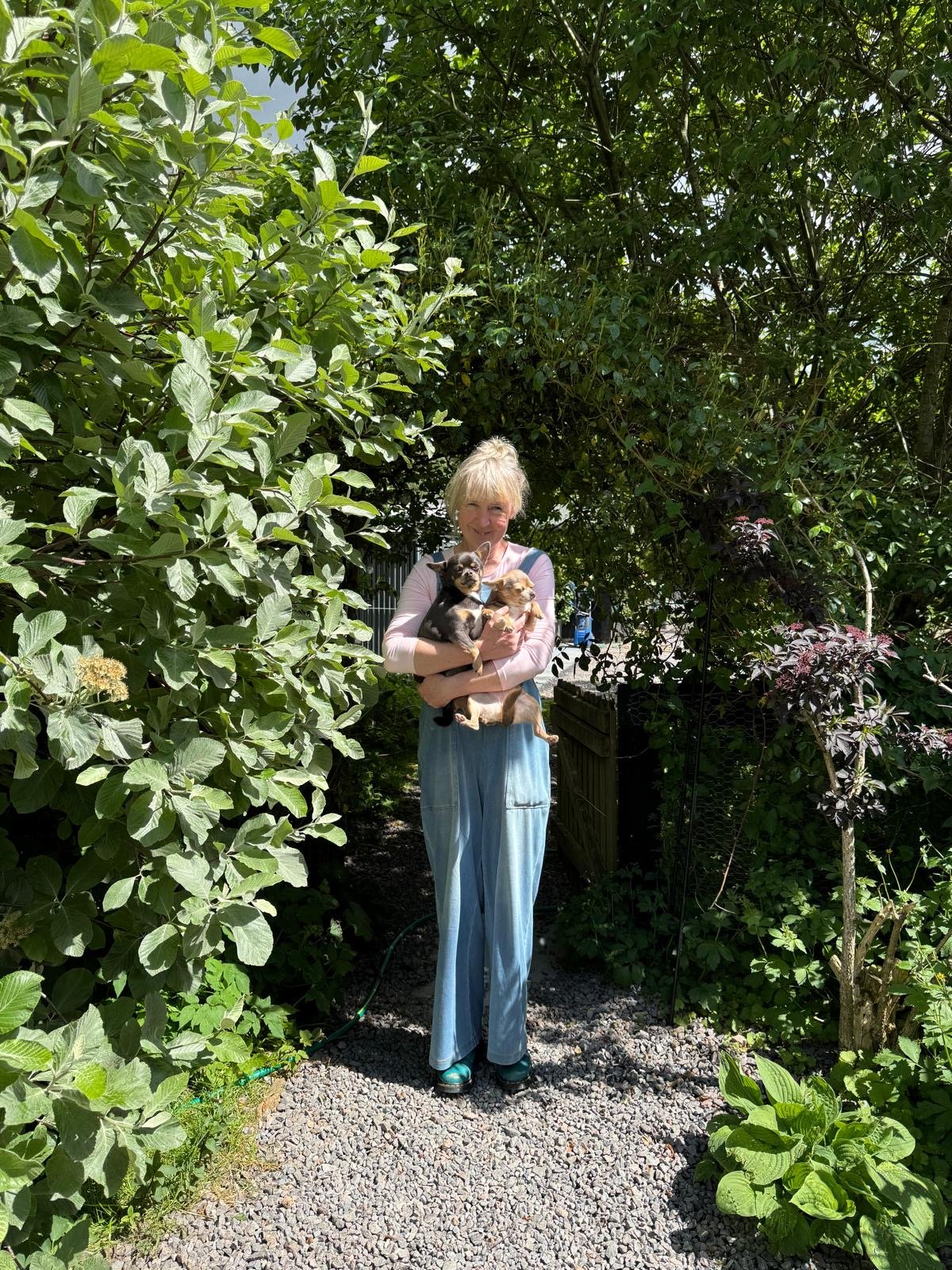
Thanks to my pal Mel Shand for my sunny pic, and for the chihuahua cuddle opportunity. I’ve written this piece because……hmmm. I felt compelled to. And these days I’m following my nose.
Less haste, more speed!” my mother used to say.
“Write it down! That way you won’t forget—NOT on your hand, unless you want blood poisoning.” Said Dad.
“Why didn’t you check the paper where you wrote it down? What do you mean you’ve lost it?”
“Why didn’t you bring your school jotters home like I specifically asked?”
“Look at the state of your toenails! You need to cut them after your next bath.”
“Look at your toenails! Why did you cut them now when I told you to wait until after your next bath? What? There are still three days to go and you’ll forget? You silly girl, you’ll ruin your feet. You need to concentrate and listen to what I say.”
More than 25 years ago, my dear husband, Spook, came rushing out of the loo, waving my copy of RED magazine in my face.
“I know what’s wrong with you!” he declared. “You’ve got ADD. Look at this.”
Is your purse a mess?
Is your handbag a mess?
Is your car a mess?
Are your cupboards a mess?
Do you rush from task to task without finishing any of them?
If so, you may have Attention Deficit Disorder.
We laughed, agreed, and moved on, because what exactly do you do with that information? Tidy everything? Finish tasks in order? No. You simply carry on as you always have, because that is who you are. It is frustrating, and friends who kindly tidy your cupboards—which helps you to breathe—come back a few weeks later, roll their eyes, and eventually stop bothering. What is the point? My best friend of more than 40 years once emptied the laundry cupboard in my caravan business and put everything back with perfect order: single, double, and king-size sheets neatly separated; towels and tea towels together; cleaning cloths here, bath mats there. It was brilliant. I no longer had to keep running up to the house because I had fetched the wrong size sheet. But when she came back a few weeks later and peeked inside, she looked at me and said, “You are a very bad girl.” I hung my head in shame, we laughed, shrugged it off, and moved on. And I carried on running up and down to the house because I still had the wrong sheets.
When I feel wronged, misjudged, or stripped of control that should be mine, and I cannot make someone understand how deeply that matters to me, my reactions can be explosive. They become so intense that they overshadow the original offence, making it easier for the other person to dismiss or distort what happened. “Well, didn’t Morag go off on one? What a scene.”
Thankfully, I can count only around ten episodes in my life that were truly bad, so most people do not know this is such a debilitating part of my personality. It would be far better handled by calmly and quietly saying that someone’s behaviour was unacceptable. But I cannot do that when I am incandescent with anger. On at least four occasions, my throat has tightened so badly that all I could produce was a high-pitched wail. Fairly enough, that does rather distract from the issue at hand. Small wonder the people on the receiving end of my fury lose sight of what they actually did wrong.
So, we move on—but not really. Rumination can last for years. My best friend often says, “Move on.” I would if I could. My deepest need is to be understood. If I could explain why I was so upset, gain some understanding, and hear even a simple acknowledgement that the incident was hurtful to me, then perhaps I could move on. Not necessarily an apology—just recognition that, yes, this was offensive to Morag. Then I could apologise for my own inexplicable behaviour, because I would finally have a chance to explain it. You see? I am not unreasonable.
The H has usually been low-key in my life, and Spook and I simply did not think I had it. I rather liked the idea of having the H—I imagined I would finally get things done. The trouble with an overpowering H, though, is that it often gets the wrong things done: things no one else is necessarily asking for. When I returned to painting 20 years ago, I was delighted. I could not wait for the children to get to school so I could paint. But I did not first put the house in reasonable order, which would only have taken 40 minutes, and chaos followed quickly. So I stopped painting. The same happened with reading. After finishing a really good book, I knew I could not risk starting another because I would not be able to put it down long enough to do anything else. So I stopped taking that risk, and gradually I read less and less.
But looking back over the past 20 years, I can see that the H is there—it simply appears on its own terms. I do not control it, and I could never predict whether it would show up when needed. It seems to be triggered by someone else’s urgent need and by the sense that I am the only person who can respond. When it does appear, it brings extraordinary clarity of thought and the ability to multitask, manage projects, and keep everyone’s needs in view. Spook says it is both terrifying and impressive.
I can clearly remember only three quite different occasions when this happened, though there may have been smaller ones too. In general, motherhood is a life of constant response rather than control. It is a nonstop roller coaster of meeting other people’s needs without the time to stop and ask whether you are doing it well. You just keep going for as long as you are needed. Sometimes it is only when that work ends that you notice the unfiltered you. And it’s not very impressive at all!
Suddenly, there is time for all the things you’ve longed to do, yet you can’t bring yourself to do any of them. You can think about them endlessly, but you still can’t begin. You look back on your life and see everything you thought you would have done by now, and none of it has happened. Did you simply forget? In truth, you know it was a lack of confidence. You rarely finish what you start, and you fear you would probably have failed. You can’t bring yourself to ask anyone for an opportunity because you suspect you wouldn’t follow through. The conclusion feels inescapable: you are all talk and no action.
Then conversations with two very different men—one in his fifties, the other in his twenties—revealed that both had recently been diagnosed with ADHD and were taking medication. The changes they described in their behaviour, though quite unlike my own, made me realise that something might actually be done about this. Endless to-do lists could get the chores done, but they left no energy for anything more creative. They took all day and felt like wading through wet cement. They were neither satisfying nor fulfilling. On my 62nd birthday, I finally booked a private ADHD assessment.
That’s it, I said to Running Girl. I’m not going to talk about this any longer. I’ve finally done something about it. And yet, for the six weeks leading up to my appointment, it was all I talked about. How do you convince someone, in two hours, that you have this condition? How does she sort through 62 years of life and separate it from mental health issues, ordinary laziness, menopause, and significant childhood loss and disruption? I felt as though I’d need a lawyer to present my case……..meanwhile, I was boring the knickers off everyone. The longest 6 weeks of Spooks life.